Wednesday, December 5, 2007

THE WAR, by Geoffrey C. Ward.


The War, the companion volume to Ken Burns' documentary, looks at first glance like the coffee table book of the season. It is, but only in the sense that, given its size, a coffee table might be the most practical place to read it. And The War, which lands in bookstores this week, should be read by everyone, from high schoolers, many of whom, as Burns points out in his introduction, "think we fought with the Germans against the Russians in the Second World War," to baby boomers, who think they know what their parents went through.
Unique not only among previous Burns companion volumes but among all books on World War II, The War pursues two main currents: the stories of four American towns during the war years and the bigger picture of both the European and Pacific fronts. The course of the war is never allowed to become too distant a subject. When battles are linked to the lives of the men who served and their friends and family in Waterbury, Conn.; Mobile, Ala.; Luverne, Minn.; and Sacramento, Calif., history becomes the stuff of personal drama.
Geoffrey C. Ward, prize-winning biographer of Franklin Roosevelt and author of companion volumes for three other Burns films, including The Civil War, handles the historical narrative deftly. What, one wonders, is left to say about this war? The answer is not so much new information as new interpretation.
Ward is tougher than almost any recent historian on the generals and war planners whose decisions were responsible for such massive blunders as the feeble defense of the Philippines in 1942 and the landing at Anzio in Italy in 1944. And the reader will be, too, when men we have come to know die needlessly.
Ward juxtaposes major events with illuminating details. In Mobile, for instance, both country music legend Hank Williams and the father of home-run hero Hank Aaron worked in the same shipyard, the kind of integration that would not have happened if not for the war effort.
But it's the personal side of the book, the stories of the common people from these towns and many others, including Japanese-Americans who went off to fight the Nazis while their parents lived behind barbed wire in interment camps, that pulls the reader in.
Their stories are told through newspaper articles, old photographs, letters to and from the front and, sometimes, most heart-rending of all, home movies that family members have kept for more than 60 years. They are also told, in many instances, by the participants themselves. All of these serve to re-create a time when Americans got their war news from the morning papers and radio rather than television and the Internet.
We find out the fate of soldiers, sailors and airmen as their loved ones find out. Each new death — usually delivered in the form of a Western Union telegram — hits the reader with the jolt of an emotional rifle slug (the reproduction of one such telegram provides one of the book's starkest photos).
Part history, part memoir and part photo album, The War is compelling on many levels. The photographs are a mesmerizing collection of both the war the GIs saw and the changing world they left behind. Many are so upsetting that for a long time they were known only to the men who took them: In the Ardennes Forest, American soldiers try to distinguish between our dead and the enemy in a pile of frozen corpses; in Dresden, a German town destroyed by Allied bombs, dead men, women and children are heaped in piles more than six feet tall; Marines on Okinawa stand around a radio looking stricken as they hear the news that the war in Europe is over. When will their war be over?
Much of The War will hit the uninitiated with a shock. Readers will begin to understand why fighter pilot Quentin Aanenson could never return to his father's farm in Minnesota. "I find there are times when I'm pulled back into the whirlpool," he says. "The intensity of that experience was so overwhelming that you can't let go of it."

AMERICAN CREATION, by Joseph J. Ellis


Academic fashion determines the way whole generations are educated, and since the '60s, as historian Joseph Ellis slyly remarks, a "hegemonic narrative" has prevailed within the academy, in which race, class, and gender are the privileged categories and the Founding Fathers of the American Republic have all too often been dismissed as the deadest of dead white males -- "racists, classists, and sexists, a kind of rogues' gallery rather than a gallery of greats." Historians have focused their attention, instead, on America's dispossessed: slaves, women, and Native Americans.
But in the last few years, the cultural focus has returned to the Founding Fathers with the appearance of a number of hugely popular new books, including bestselling biographies of Adams, Franklin, Hamilton, and Washington. The Founders are back: back with a vengeance, thanks to writers like Ellis himself, whose elegant, balanced books on the Founding era and biographies of Jefferson, Adams, and Washington have done much to return the public's attention to this remarkable group of men and their accomplishments.
Part of the urgent new interest in the founders might be attributable to the attacks currently being made on their greatest achievements, the United States Constitution and the Bill of Rights. The significance of habeas corpus, for instance, such a tortured issue today, can best be understood by going back to James Madison and the context within which he pressed for its enshrinement in the new nation's law. Another attraction is the way the Founders, brilliant men by any standards, shine by contrast with our present-day political leaders. As Henry Adams remarked way back in the 19th century, if you looked at all the American presidents panoramically, you would have to conclude that Darwin got it exactly backward.
The question that has always fascinated Ellis -- and so many other historians of the Founding era -- is, "How did they do it?" In American Creation: Triumphs and Tragedies at the Founding of the Republic, Ellis states the case.
During the last quarter of the eighteenth century a former colony of Great Britain, generally regarded as a provincial and wholly peripheral outpost of Western Civilization, somehow managed to establish a set of ideas and institutions that, over the stretch of time, became the blueprint for political and economic success for the nation-state in the modern world…. [These institutions included] representative government bottomed on the principle of popular sovereignty, a market economy fueled by the energies of unfettered citizens, a secular state unaffiliated with any official religion, and the rule of law that presumed the equality of all citizens.Posterity has generally deemed these achievements triumphs. But there were blunders at the Founding, too, disasters that might have been averted but were not, causing tragedy and all but tearing the Union to pieces. Most notable among these was the failure to end slavery, or at least to come up with a gradual scheme for emancipation, and the failure to create and enforce a fair settlement with the Native Americans. Ellis takes a close look at both the triumphs and the tragedies, showing us new facets of the familiar stories.
What makes Ellis's work so persuasive is his unwillingness to see the Founders in a simplistic light, either as ideal heroes or as racist villains. They were great men but undoubtedly flawed ones, and none of them has escaped with his reputation unstained. As Ellis remarks, "It is uncommon for the same men who make a revolution also to secure it," and the process of securing it involved compromises that some of the protagonists found nearly unbearable.
In a fascinating chapter on the creation and ratification of the Constitution, Ellis argues that the climax of that particular drama was not the Constitutional Convention of 1787 but the Virginia Ratifying Convention of 1788, which pitted a cast of titans against each other in a bitter fight over federal versus state authority. James Madison and George Washington, backed by Alexander Hamilton, argued in favor of a model in which federal authority would supersede that of the individual states, while George Mason and the great orator Patrick Henry fought for the principal of state sovereignty and a minimum of centralized power. The Henry-Madison debate in June 1788 was, Ellis claims, possibly "the most consequential debate in American history" -- even more so than the Lincoln-Douglas debates over slavery or the Darrow-Bryan one on evolution.
Eventually, the two sides were obliged to come to a compromise that pleased hardly anyone; in fact, Madison, at that time, felt that he had lost all the major battles and that "the principal of state sovereignty had been qualified but not killed, as he believed it should be." Ellis points out that the solution was a fruitful one in spite of itself, "making argument itself the answer by creating a framework in which federal and state authority engaged in an ongoing negotiation for supremacy, thereby making the Constitution, like history itself, an argument without end." Not quite entirely without end, perhaps; an end of sorts to aspects of the argument would certainly come on the battlefields of the Civil War.
The Antifederalist fear -- some have called it paranoia -- is worth considering. Its spokesmen, from Patrick Henry to its modern proponents, have argued that once in place, the federal government's "relentless expansion of arbitrary power was unstoppable, its tendency toward corruption was inevitable, and its appetite for despotism was unquenchable" -- an anti–Big Government position, in other words. For much of our country's history, this complaint came from the political right; now, though, it is gaining new adherents from the center and left, due to the Bush administration's unprecedented usurpation of power. The argument lives on, it seems.
In two subsequent chapters, Ellis shows how both Madison and Jefferson changed their positions due to the exigencies of political life after 1788. The beginning of the two-party system in 1791 defied everyone's conceptions of what the Constitutional government was supposed to be about, and it was psychologically impossible for Washington and Adams, "the last of a classical breed" and instinctively nonpartisan, to conceive of themselves as party men. But Alexander Hamilton's new fiscal programs led Madison and Jefferson, the southern agrarians, to fear that the Republic was being taken over by a sinister conspiracy of northern bankers and money men: the federal government, they believed, was running amok. Thus was born the Republican Party, with Jefferson at its head and Madison as his right hand.
"Given [Madison's] role as the most prominent Federalist of all in 1787-88, for him to recognize the Antifederalists as the heroic predecessors of the Republicans was akin to having Martin Luther declare his ultimate allegiance to the Vatican," Ellis comments dryly. Jefferson, too, was now displaying protean qualities that would ultimately lead him to defy any sort of political classification. When it became evident, during his presidency, that Napoleon Bonaparte was considering offering the Louisiana Territory for sale, Jefferson displayed his willingness to act unconstitutionally if the occasion demanded. "Throughout the 1790s he had labeled the Federalists 'monarchists' and insisted that any energetic projection of executive power violated republican principles. Now, he had just performed the most aggressive executive action ever by an American president, a projection of executive authority that would stand the test of time as perhaps the boldest in American history. If one wished to acquire an empire, it turned out, one had to become an imperial president."
It is hard to see how the two principal tragedies of the Founding era could have been evaded. Ellis shows us how during his first presidential term Washington, encouraged by Secretary of War Henry Knox, tried hard to create and implement a fair deal for the Native Americans in accordance with the republican principles for which the revolution had been fought. "It would reflect honor on the new government," Knox wrote, "were a declarative Law to be passed that the Indian tribes possess the right of the soil of all lands…and that they are not to be divested thereof but in consequence of fair and bona fide purchases, made under the authority, or with the express approbation of the United States." Knox and Washington envisioned a series of Indian homelands east of the Mississippi, protected by the federal government, that would eventually become states, but for many reasons -- especially the unstoppable streams of white settlers pouring into the Indian territories -- their efforts ended in debacle. It was a debacle Washington took personally, Ellis tells us, "believing that his signature on the [failed] Treaty of New York was his pledge of honor, as well as the solemn word of the United States government. Both were now being exposed as worthless."
The issue of slavery was, of course, the single most divisive question that faced the Founders. It was almost foreordained that the Constitution would fail to settle it, since there was no possible settlement that the 13 states could have agreed on: the Union would have dissolved before it even existed. But the Founders' failure on this subject went beyond a mere politic silence. As a group they were simply unable to imagine a functional biracial society. The resultant fissures in the newborn Republic were more than evident to the founding generation, but these men chose to push the inevitable earthquake into the future. It is a difficult choice to approve -- but a different course of action would probably have doomed the nascent Republic.
The most interesting aspect of Ellis's take on the Founders and their work is his vision -- a correct one, I think -- of the Union and the Constitution they created as ever-evolving, non-monolithic entities. Ellis's characterization of the Constitution as "an argument without end" has proved to be a just one, as anyone can see by tuning in to the Senate proceedings on C-SPAN today. Showing us the founding era as a series of philosophical conflicts and painful compromises rather than the triumphal progress celebrated in school textbooks makes American history -- and the embattled American present -- more comprehensible, and infinitely more accessible. --Brooke Allen
Brooke Allen is the author of Moral Minority: Our Skeptical Founding Fathers; Twentieth-Century Attitudes; and Artistic License. She is a contributor to The New York Times Book Review, The New Criterion, The New Leader, The Hudson Review, The Nation, and more.

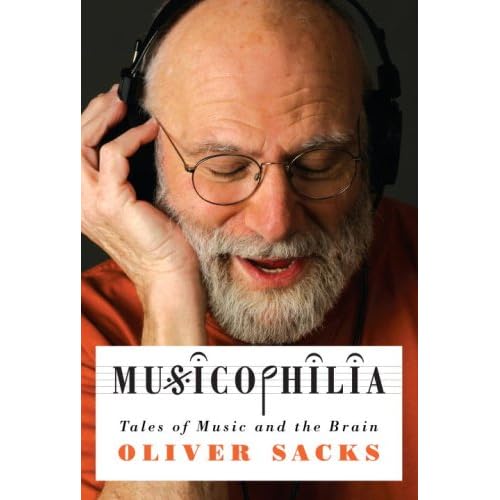
MUSICOPHILIA, by Oliver Sacks.


Music can move us to the heights or depths of emotion. It can persuade us to buy something, or remind us of our first date. It can lift us out of depression when nothing else can. It can get us dancing to its beat. But the power of music goes much, much further. Indeed, music occupies more areas of our brain than language does--humans are a musical species.
Oliver Sacks's compassionate, compelling tales of people struggling to adapt to different neurological conditions have fundamentally changed the way we think of our own brains, and of the human experience. In Musicophilia, he examines the powers of music through the individual experiences of patients, musicians, and everyday people--from a man who is struck by lightning and suddenly inspired to become a pianist at the age of forty-two, to an entire group of children with Williams syndrome who are hypermusical from birth; from people with "amusia," to whom a symphony sounds like the clattering of pots and pans, to a man whose memory spans only seven seconds--for everything but music.
Our exquisite sensitivity to music can sometimes go wrong: Sacks explores how catchy tunes can subject us to hours of mental replay, and how a surprising number of people acquire nonstop musical hallucinations that assault them night and day. Yet far more frequently, music goes right: Sacks describes how music can animate people with Parkinson's disease who cannot otherwise move, give words to stroke patients who cannot otherwise speak, and calm and organize people whose memories are ravaged by Alzheimer's or amnesia.
Music is irresistible, haunting, and unforgettable, and in Musicophilia, Oliver Sacks tells us why.

LONE SURVIVOR, by Marcus Luttrell with Patrick Robinson.


Four US Navy SEALS departed one clear night in early July, 2005 for the mountainous Afghanistan-Pakistan border for a reconnaissance mission. Their task was to document the activity of an al Qaeda leader rumored to have a small army in a Taliban stronghold. Five days later, only one of those Navy SEALS made it out alive.
This is the story of the only survivor of Operation Redwing, fire team leader Marcus Luttrell, and the extraordinary firefight that led to the largest loss of life in American Navy SEAL history. His teammates fought valiantly beside him until he was the only one left alive, blasted by an RPG into a place where his pursuers could not find him. Over the next four days, terribly injured and presumed dead, Luttrell crawled for miles through the mountains and was taken in by sympathetic villagers who risked their lives to keep him safe from surrounding Taliban warriors.
A born and raised Texan, Marcus Luttrell takes us from the rigors of SEAL training, where he and his fellow SEALs discovered what it took to join the most elite of the American special forces, to a fight in the desolate hills of Afghanistan for which they never could have been prepared. His account of his squadmates' heroism and mutual support renders an experience for which two of his squadmates were posthumously awarded the Navy Cross for combat heroism that is both heartrending and life-affirming. In this rich chronicle of courage and sacrifice, honor and patriotism, Marcus Luttrell delivers a powerful narrative of modern war.

QUIET STRENGTH, by Tony Dungy with Nathan Whitaker.


Tony Dungy's words and example have intrigued millions of people, particularly following his victory in Super Bowl XLI, the first for an African American coach. How is it possible for a coach--especially a football coach--to win the respect of his players and lead them to the Super Bowl without the screaming histrionics, the profanities, the demand that the sport come before anything else? How is it possible for anyone to be successful without compromising faith and family? In this inspiring and reflective memoir, Coach Dungy tells the story of a life lived for God and family--and challenges us all to redefine our ideas of what it means to succeed. Includes a foreword by Denzel Washington and a 16-page color photo insert.

THE AGE OF TURBULENCE, by Alan Greenspan


Later this year, Alan Greenspan's memoir will be released, titled "The Age of Turbulence."
Publication date is Sept. 17 (you cannot yet pre-order it on Amazon). Greenspan's editor is pushing the rumor that the Maestro's promotional tour will include an appearance on the Tonite Show with Jay Leno.
There are lots of books about The Maestro (including Bob Woodward 's Maestro). Many are less than flattering, with titles like Greenspan's Fraud; Who Shot Goldilocks?; and Bubble Man;
I still get a chuckle every time I recall the Onion quote about his retirement: "I guess the crash-and-burn lifestyle of a 'chairman of the Federal Reserve' finally caught up with the guy."

BORN STANDING UP, by Steve Martin.


The history of Western culture is full of artists who bled, starved, or courted madness for their work and their audience. But come on: How many of those phonies stuck an arrow through their head for us? Steve Martin's Born Standing Up is a spare, unexpectedly resonant remembrance of things past, the things in question being balloon animals and bunny ears, as well as the awkwardness Martin felt with his sullen father and the profound silliness he himself unleashed on stage. The book is unexpected not because fans have forgotten the sunburst that was Martin's stand-up but because you'd be forgiven for wondering if he has. It's been decades since he began reinventing himself as a wry, quietly powerful novelist, a snowy-haired movie dad, and a real, as opposed to ironic, sophisticate. ''I ignored my stand-up career for twenty-five years,'' he writes, ''but now, having finished this memoir, I view this time with surprising warmth. One can have, it turns out, an affection for the war years.''
Martin's prose is unusually meditative for a guy who once insisted that the ozone layer had to be saved because it was shielding us from another, more distant layer — of farts. Off stage, he always tended toward the non-wild and not-so-crazy. By 15, Martin was doing magic acts for Cub Scouts and making notes: ''Leave out unessasary [sic] jokes... relax, don't shake... charge money.'' At 20, he performed for a week at a club in San Francisco, where a sign in the kitchen read ''Anyone giving money to Janis Joplin before her last set is fired!'' It was here that his act became not comedy but ''a parody of comedy.'' Every desperate thing he'd done just to fill a 25-minute set — balloons, banjo playing, nose-glasses — suddenly cohered.
Describing the road to his colossal fame, Martin drops tidbits about being intimidated by Linda Ronstadt (''Steve, do you often date girls and not try to sleep with them?'') and passing Elvis backstage in Vegas (''Son, you have an ob-leek sense of humor''). He talks about anxiety attacks and his father's death. But this is not some star's tell-all. Martin's one true subject is the evolution of his comedy — the transcendent moments when he realized, say, that punchlines were the enemy, that a white suit could be seen better in a concert hall. Born is a smart, gentlemanly, modest book. That it comes from a man who's spent his life lampooning arrogance makes it all the more winning. In 2001, while hosting the Oscars, Martin had a one-liner that deserves to be remembered as one of the great skewerings of celebrity vanity. ''Please hold your applause,'' he said. ''Until it's for me.'' Fair enough. Here it comes: A