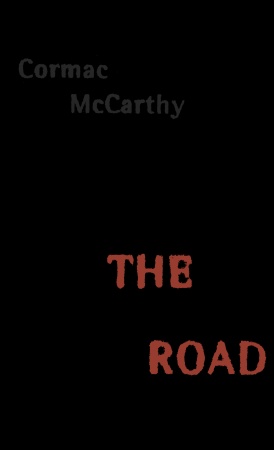
 “Despite Cormac McCarthy’s reputation as an ornate stylist, The Road represents both the logical terminus, and a kind of ultimate triumph, of the American minimalism that became well-known in the 1980s under the banner of ‘dirty realism’ . . . The Road is a much more compelling and demanding book than its predecessor . . . The new novel will not let the reader go, and will horribly invade his dreams, too . . . The Road is not a science fiction, not an allegory, and not a critique of the way we live now, or of the-way-we-might-live-if-we-keep-on-living-the-way-we-live-now. It poses a simpler question, more taxing for the imagination and far closer to the primary business of fiction-making: what would this world without people look like, feel like? These questions McCarthy answers magnificently . . . [His] devotion to detail, his Conradian fondness for calmly described horrors, his tolling fatal sentences, make the reader shiver with fear and recognition . . . When McCarthy is writing at his best, he does indeed belong in the company of the American masters. In his best pages one can hear Melville and Lawrence, Conrad and Hardy. His novels are full of marvelous depictions of birds in flight, and The Road has a gorgeous paragraph like something out of Hopkins . . . The writing [is] often breathtaking.”–James Wood, The New Republic
Showing posts with label R. Show all posts
Showing posts with label R. Show all posts
Thursday, December 6, 2007
THE ROAD, by Cormac McCarthy.
“Despite Cormac McCarthy’s reputation as an ornate stylist, The Road represents both the logical terminus, and a kind of ultimate triumph, of the American minimalism that became well-known in the 1980s under the banner of ‘dirty realism’ . . . The Road is a much more compelling and demanding book than its predecessor . . . The new novel will not let the reader go, and will horribly invade his dreams, too . . . The Road is not a science fiction, not an allegory, and not a critique of the way we live now, or of the-way-we-might-live-if-we-keep-on-living-the-way-we-live-now. It poses a simpler question, more taxing for the imagination and far closer to the primary business of fiction-making: what would this world without people look like, feel like? These questions McCarthy answers magnificently . . . [His] devotion to detail, his Conradian fondness for calmly described horrors, his tolling fatal sentences, make the reader shiver with fear and recognition . . . When McCarthy is writing at his best, he does indeed belong in the company of the American masters. In his best pages one can hear Melville and Lawrence, Conrad and Hardy. His novels are full of marvelous depictions of birds in flight, and The Road has a gorgeous paragraph like something out of Hopkins . . . The writing [is] often breathtaking.”–James Wood, The New Republic
Tuesday, December 4, 2007
RESCUING SPRITE, by Mark R. Levin.
 Although Mark Levin is known as a constitutional lawyer and a nationally syndicated broadcaster, he is, first and foremost, a dog lover. In 1998, he and his family welcomed a half-Border Collie/half-Cocker Spaniel they named Pepsi into their lives. Six years later, his wife and son persuaded him to adopt a dog from the local shelter, a Spaniel mix. It turned out he was older than originally thought, and he was the most beautiful dog they'd ever seen. They named him Sprite. Their lives would never be the same.Sprite and Pepsi became fast friends. They did everything together, from rummaging through the trash to loudly greeting the deliveryman. And the Levin family fell in love with him -- with his gentle nature, beautiful face and soft, huggable fur. But on Halloween night, shortly after joining their family, Sprite suddenly collapsed and was rushed to the animal hospital. It was the first of many such visits, and the start of a long journey for the Levin family, filled with much joy and anguish.During the next two years, Sprite and Pepsi were inseparable. And Sprite's bond with the Levin family deepened. Friends, neighbors, and even Mark's radio audience came to know and love Sprite. As Mark's daughter turned eighteen and graduated from high school and Mark's son turned fifteen, Sprite's health deteriorated -- even as his spirits remained high and his beauty and grace continued to inspire. Between Thanksgiving and Christmas 2006, the Levin family said their emotional final goodbye. Crushed and consumed with grief, Mark turned to family, friends, and fans for help.But new hope came when the Levins least expected it.Rescuing Sprite is a stunningly intimate look atthe love between a family and a dog, one that movingly shows, in Mark Levin's words, that "in the end, we humans are the lucky ones."The author will donate a portion of his proceeds from the sale of this book to animal shelters.
RHETT BUTLER’S PEOPLE, by Donald McCaig.

Like no other book, Margaret Mitchell's Gone With The Wind is inexorably bound up with my Southern girlhood. I discovered it when I was 8 or 9 on my grandmother's bookshelf and, over the years, spent many an hour lost in its pages. But my professor father — who'd gone to some pains to teach his children about the Civil War and its ramifications — dismissed the novel as frippery, a soap opera.
A soap opera? You bet. But what a soap opera, one of the finest ever written, revolving around a spunky, black-haired, green-eyed girl and her love for the wrong man, set against the fiery backdrop of the Civil War. When the first GWTW sequel, Alexandra Ripley's Scarlett, came out in 1991, I was indignant. Was nothing sacred? Oddly, when I heard about Donald McCaig's sequel, Rhett Butler's People, some 12 years in the writing, I was curious. McCaig, unlike Ripley, has a reputation as a real writer, with two acclaimed Civil War novels to his name.
Just as Ripley's book traced Scarlett's life, McCaig's explores Rhett's. The early chapters function as a prequel, a description of Rhett's childhood as the wild son of a low-country rice planter. McCaig fleshes out Rhett's teens and 20s, inventing the details that transformed him into Mitchell's famous reprobate and blackguard. Young Rhett bears biographical similarities to Jefferson Davis, president of the Confederacy. McCaig, unlike Ripley once again, knows his facts; his historical depictions are largely correct (and he acknowledges in an afterword where he took liberties). He also corrects Mitchell's romanticized view of the war and reconstruction — his South is one of loss and ruin.
But he strays into all kinds of problems when his story line leaps, timewise, past GWTW's, to ludicrous effect. Then there are the characters: Though he's able to effect a credible Rhett (and he's pretty dead-on with Suellen Benteen, one of Scarlett's sisters, as well as with her simpering aunt Pittypat), he's not much good at Mammy, Melanie, or even Scarlett. Do I think, in a million years, that Scarlett would've kissed a drowsy Rhett and said, ''I'd better see to the children. There'll be coffee when you come down''? Fat chance. Or that she would have confided to Rhett's sister, ''I feel like a maiden again.... I pray life will be good to me!'' (I actually laughed out loud at that one.) McCaig's a decent writer, and the plot is better than middling. But he's missed the point about Scarlett — nothing affected her indomitable spirit and innate selfishness. And since everything must come back to her in the end — as it does even in McCaig's
A soap opera? You bet. But what a soap opera, one of the finest ever written, revolving around a spunky, black-haired, green-eyed girl and her love for the wrong man, set against the fiery backdrop of the Civil War. When the first GWTW sequel, Alexandra Ripley's Scarlett, came out in 1991, I was indignant. Was nothing sacred? Oddly, when I heard about Donald McCaig's sequel, Rhett Butler's People, some 12 years in the writing, I was curious. McCaig, unlike Ripley, has a reputation as a real writer, with two acclaimed Civil War novels to his name.
Just as Ripley's book traced Scarlett's life, McCaig's explores Rhett's. The early chapters function as a prequel, a description of Rhett's childhood as the wild son of a low-country rice planter. McCaig fleshes out Rhett's teens and 20s, inventing the details that transformed him into Mitchell's famous reprobate and blackguard. Young Rhett bears biographical similarities to Jefferson Davis, president of the Confederacy. McCaig, unlike Ripley once again, knows his facts; his historical depictions are largely correct (and he acknowledges in an afterword where he took liberties). He also corrects Mitchell's romanticized view of the war and reconstruction — his South is one of loss and ruin.
But he strays into all kinds of problems when his story line leaps, timewise, past GWTW's, to ludicrous effect. Then there are the characters: Though he's able to effect a credible Rhett (and he's pretty dead-on with Suellen Benteen, one of Scarlett's sisters, as well as with her simpering aunt Pittypat), he's not much good at Mammy, Melanie, or even Scarlett. Do I think, in a million years, that Scarlett would've kissed a drowsy Rhett and said, ''I'd better see to the children. There'll be coffee when you come down''? Fat chance. Or that she would have confided to Rhett's sister, ''I feel like a maiden again.... I pray life will be good to me!'' (I actually laughed out loud at that one.) McCaig's a decent writer, and the plot is better than middling. But he's missed the point about Scarlett — nothing affected her indomitable spirit and innate selfishness. And since everything must come back to her in the end — as it does even in McCaig's
Subscribe to:
Posts (Atom)
