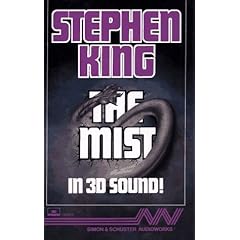
This adaptation of the Stephen King story (found in Skeleton Crew)is perfect for long car rides. Even more so if you have to drive at night. This story of an inexplicable mist that engulfs a small, New England town has long been a fan favorite and this superb production helps prove why. The screams and cries of pain are startling, the sound effects make this work incredibly, allowing for a real level of fear to develop. The voice acting (for the most part) is amazing. This really isn't an audio book as much as it is audio theater, kinda like the old radio shows. The Mist is an experience that Stephen King fans ought to know, especially if you have ever read the story. Also, Frank Darabont (director of The Shawshank Redemption and The Green Mile)has the movie rights to the story. And if this cd doesn't whet your appetite for the film adaptation I don't know what will. A prime example that radio is still a powerful storytelling medium.
Showing posts with label m. Show all posts
Friday, December 7, 2007
Thursday, December 6, 2007
THE MEMORY KEEPER’S DAUGHTER, by Kim Edwards
Read with both understanding and understatement film and stage actress Martha Plimpton delivers a first rate performance of Kim Edwards's debut novel. Stage trained voices tend to have an added richness, a resonance not found among other audio book readers. Such is the case with Plimpton in this story of a Down's Syndrome child and the two families she binds together. When Dr. David Henry's wife goes into labor during a paralyzing winter storm he is forced to deliver his child. His wife, Nora, is under heavy sedation and he is assisted by Caroline, his nurse. Henry's joy is boundless when he delivers a healthy son and also discovers that he is to be the father of twins. With the birth of his second child, a daughter, he makes an immediate and fateful decision. The child is born with Down's Syndrome so believing that he will spare his wife pain he tells Caroline to immediately take the child to an institution and never reveal what she has done. He tells Nora that their son's fraternal twin died at birth. Caroline is far too kind hearted to obey Henry's orders, so she flees to another city where she raises the daughter, Phoebe. We can never know whether some decisions we make are for good or ill or what effect they will have upon the future lives of those we love. Author Edwards traces the story of this particular family over 25 years as Nora mourns the loss of her baby girl, and a long kept secret is revealed.
Wednesday, December 5, 2007
MY GRANDFATHER’S SON, by Clarence Thomas.
Clarence Thomas, the most conservative justice on a distinctly conservative U.S. Supreme Court, may well be the nation's most polarizing legal figure, and so it is only fitting that he has penned a polarizing memoir. In addition to chronicling his amazing journey from crushing poverty in his native Georgia to the nation's highest court, "My Grandfather's Son" is a furious assault on liberalism generally and on what Thomas calls the liberal political elite that sought to derail his confirmation.In his 15 years on the high court, the 59-year-old justice has long since established his once-doubted legal and intellectual bona fides. Yet with an eye on posterity, he seems to crave validation as having deserved his appointment and, more broadly, as a noble man fighting to do the right thing in an often bigoted, deceitful world. As Thomas puts it in his preface, he is rescuing his own history from the "careless hands" and "malicious hearts" of unnamed others.Whether Thomas' much-anticipated memoir will advance this cause is doubtful. Thomas' supporters will cheer his often eloquent and always feisty accounts in which every liberal idea is derided as a foolish "piety" belied by his life experience. But his polemical, score-settling approach is likely only to deepen the enmity of his detractors.Nowhere is this more true than in Thomas' treatment of the he-said / she-said conflagration over Anita F. Hill's charges that he made crude sexual advances toward her. Neither his successful Senate confirmation in 1991 nor the passage of time has mellowed his view of what he then famously decried as a "high-tech lynching." Spewing invective, Thomas depicts Hill as an abrasive, vindictive, politically motivated liar exploited by a "smooth-tongued" liberal "mob" (including a biased press) that was hell-bent on his personal destruction to prevent a more conservative court from overturning Roe vs. Wade. He casts himself as Tom Robinson, the black man wrongly accused of rape in "To Kill a Mockingbird," his favorite book as a youth. (Hill, a professor at Brandeis University, has declined to comment on the book or Thomas' characterization of her as a "mediocre" but ambitious lawyer and "my most traitorous adversary.")Thomas is refreshingly candid about the depths of his suffering, and one comes away with a deep sadness about our broken politics and the ferocious disincentives for anyone to seek high government appointment.Baring emotional wounds, however, is not the same as presenting a convincing case of innocence. Since the confirmation hearings, several careful journalists have shown that he was nothing like the uptight, prudish figure he presented at the time -- someone who could not possibly have talked about pubic hairs and Long Dong Silver. In law school, Thomas was a voracious consumer of pornography with a coarse sense of humor -- and credible evidence exists that his pornographic interest extended much later into his life. Thomas cops to none of this except to note briefly that, from "immaturity," he might have joined in a few discussions of pornography at Yale, when the movie "Deep Throat" and its ilk were mainstream cultural phenomena. Nor does he address others' claims that would seem to corroborate Hill's charge that Thomas made unwanted sexual advances toward her when she worked for him at the U.S. Equal Employment Opportunity Commission.This doesn't necessarily mean that Hill's accusations were true. It does mean that Thomas' sense of outrage is exaggerated and one-sided. He rails against a vast left-wing conspiracy for distorting his true character. Yet the portrait painted by his supporters at the time and now by Thomas was (and is) also false. For all his fury at those who so intrusively investigated him, he has only praise for those who slung the mud at Hill, tarring her with little foundation as journalist David Brock did in describing her as "a little bit nutty, a little bit slutty."The risk is that Thomas' polemical rendering of his confirmation fight will overshadow more effective -- and in some ways more important -- parts of his memoir. The enigma of Thomas has always been how a black man growing up in the Jim Crow South, who lived the American dream at least partly due to affirmative action, could be so intractably conservative and so scornful of the very programs from which he benefited."My Grandfather's Son" answers this question powerfully. As the title indicates, Thomas was reared by his grandfather, Myles Anderson, because his father abandoned him as a toddler and his mother hadn't the wherewithal to raise him. To say that Anderson practiced tough love is an understatement. He beat Thomas, denied him sports (despite the boy's athletic prowess) and subjected him at a tender age to hard physical labor. Emotionally remote, Anderson later kicked him out of the house when -- in a major break from his parochial upbringing -- Thomas decided to leave a Missouri seminary college.But as Thomas lovingly recounts, his grandfather taught him self-reliance, tenacity and religious faith. These gave him a resilience and independent spirit that Thomas convincingly credits with allowing him to leave behind the specter of an unproductive and potentially crime-ridden life and, instead, to excel amid widespread bigotry and want.Although Thomas' conservatism emerged after a flirtation with lefty radicalism, the rightward turn follows with perfect logic from the searing emotional lessons of his childhood. He was taught to steel himself against weakness, despise dependency and overcome racism through individual excellence. He did so, brilliantly, to the point where his greatest resentment comes from being the recipient of an unwanted helping hand -- the affirmative action program that helped him gain entrance to Yale. For Thomas, this was not a welcome door-opener, but rather "the soft underbelly of his career," a debasing of his own genuine achievement that encouraged doubts about his abilities.Although Thomas ends the memoir at the moment he is sworn in as a justice, his Supreme Court opinions are a natural extension of the narrative. His jurisprudence is most notable for his virulent opposition to affirmative action (including a rejection of the idea, belied by Thomas' own experience, that minority students learn better in a multi-racial environment), his attack on the constitutionality of New Deal-style social programs and his support for a more active role for religion in public life.This correlation between personal values, political beliefs and constitutional philosophy pose an ironic dilemma for the author. Of all the justices, Thomas has been among the most adamant in insisting that it is wrong for a judge's moral preferences and personal experiences to color his view of the law. Yet the memoir suggests on almost every page that Thomas has followed the opposite approach -- that his legal views appear to be the sum of his life experiences, that he is his grandfather's son both as a man and as a justice. This revelation, perhaps unintended, has the virtue of honesty, but whether it is a cause for celebration or worry depends entirely on where one stands along the chasm that divides our political culture.
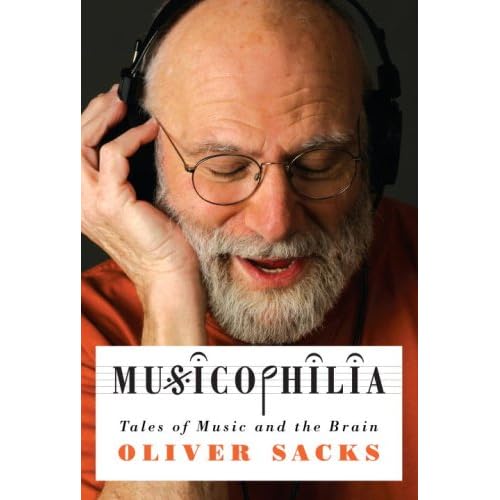
MUSICOPHILIA, by Oliver Sacks.
Music can move us to the heights or depths of emotion. It can persuade us to buy something, or remind us of our first date. It can lift us out of depression when nothing else can. It can get us dancing to its beat. But the power of music goes much, much further. Indeed, music occupies more areas of our brain than language does--humans are a musical species.
Oliver Sacks's compassionate, compelling tales of people struggling to adapt to different neurological conditions have fundamentally changed the way we think of our own brains, and of the human experience. In Musicophilia, he examines the powers of music through the individual experiences of patients, musicians, and everyday people--from a man who is struck by lightning and suddenly inspired to become a pianist at the age of forty-two, to an entire group of children with Williams syndrome who are hypermusical from birth; from people with "amusia," to whom a symphony sounds like the clattering of pots and pans, to a man whose memory spans only seven seconds--for everything but music.
Our exquisite sensitivity to music can sometimes go wrong: Sacks explores how catchy tunes can subject us to hours of mental replay, and how a surprising number of people acquire nonstop musical hallucinations that assault them night and day. Yet far more frequently, music goes right: Sacks describes how music can animate people with Parkinson's disease who cannot otherwise move, give words to stroke patients who cannot otherwise speak, and calm and organize people whose memories are ravaged by Alzheimer's or amnesia.
Music is irresistible, haunting, and unforgettable, and in Musicophilia, Oliver Sacks tells us why.
Oliver Sacks's compassionate, compelling tales of people struggling to adapt to different neurological conditions have fundamentally changed the way we think of our own brains, and of the human experience. In Musicophilia, he examines the powers of music through the individual experiences of patients, musicians, and everyday people--from a man who is struck by lightning and suddenly inspired to become a pianist at the age of forty-two, to an entire group of children with Williams syndrome who are hypermusical from birth; from people with "amusia," to whom a symphony sounds like the clattering of pots and pans, to a man whose memory spans only seven seconds--for everything but music.
Our exquisite sensitivity to music can sometimes go wrong: Sacks explores how catchy tunes can subject us to hours of mental replay, and how a surprising number of people acquire nonstop musical hallucinations that assault them night and day. Yet far more frequently, music goes right: Sacks describes how music can animate people with Parkinson's disease who cannot otherwise move, give words to stroke patients who cannot otherwise speak, and calm and organize people whose memories are ravaged by Alzheimer's or amnesia.
Music is irresistible, haunting, and unforgettable, and in Musicophilia, Oliver Sacks tells us why.
Monday, December 3, 2007
The Miracle Within by Jack Mccubbin
The beauty of developing life is captured eloquently in the book, “The Miracle Within” by Jack McCubbin, M.D. and Cathy Schaffer. For every woman who is now pregnant or is considering having a baby, this beautiful book will be an inspiration.
Photography, artist’s depictions, loving quotations, and a gentle, guiding narration will carry the reader through nine months of the gestation process. Straightforward, easy to understand, text portrays every step of the development of a baby. Guidance in the way of taking care of yourself as an expectant mother is given, regarding what you eat, what you partake of, the exercise you need, and tests you might have performed. The emotional side of pregnancy is also discussed, in a caring, loving manner.
The authors are well versed in their guidance. Jack H. McCubbin, M.D. has delivered thousands of babies and Cathy Schaffer, PA-C, has worked extensively with women suffering from high-risk medical problems during pregnancy. Together, they offer a book that is a helpful tool and resource for information, but is also an awe-inspiring collection of photographs of every stage of fetal development. This book should make an appearance at every baby shower and ought to be on the list of things to buy, right along with those prenatal vitamins.
Photography, artist’s depictions, loving quotations, and a gentle, guiding narration will carry the reader through nine months of the gestation process. Straightforward, easy to understand, text portrays every step of the development of a baby. Guidance in the way of taking care of yourself as an expectant mother is given, regarding what you eat, what you partake of, the exercise you need, and tests you might have performed. The emotional side of pregnancy is also discussed, in a caring, loving manner.
The authors are well versed in their guidance. Jack H. McCubbin, M.D. has delivered thousands of babies and Cathy Schaffer, PA-C, has worked extensively with women suffering from high-risk medical problems during pregnancy. Together, they offer a book that is a helpful tool and resource for information, but is also an awe-inspiring collection of photographs of every stage of fetal development. This book should make an appearance at every baby shower and ought to be on the list of things to buy, right along with those prenatal vitamins.
Sunday, December 2, 2007
90 MINUTES IN HEAVEN, by Don Piper with Cecil Murphey
Subscribe to:
Posts (Atom)